Amarillo and the Texas Panhandle
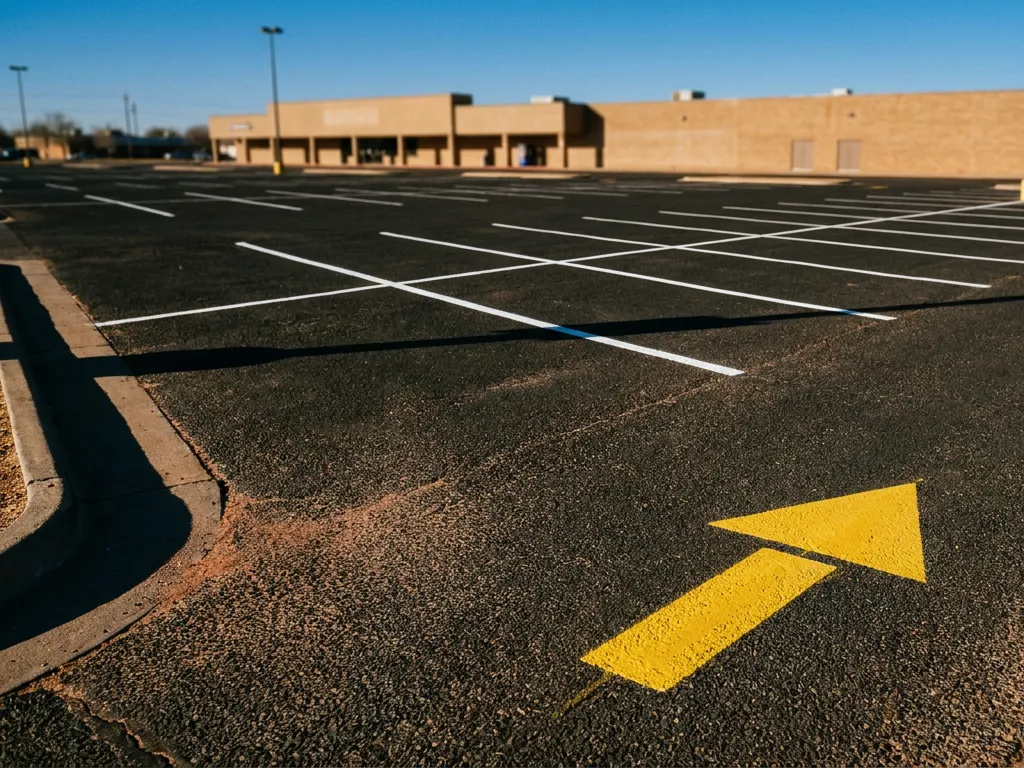
Parking lot striping in Amarillo, Texas
Amarillo Lot Striping lays out and paints commercial parking across Amarillo and the surrounding Texas Panhandle. Measured on the ground, priced in writing, and specified at a film thickness that survives the sun out here.
- Service radius
- 60 miles
- Quote visit
- No charge
- Accessible stalls
- Measured every time
What we do, and how the work is actually priced
Amarillo Lot Striping is a parking lot striping and pavement marking company working in Amarillo, Texas and the towns around it. Most of what we are called for is one of three things: a lot whose lines have faded past the point of being readable, a lot being sealed that will need every line put back afterwards, or a property where somebody has finally looked closely at the accessible parking and found it does not measure what it should.
Striping is priced from a schedule of items rather than by area. Stalls, accessible spaces, arrows, symbols, legends, stop bars, kerb footage and fire lane are each counted, which is why a small lot with a fire lane and four accessible spaces can cost more than a larger lot with a hundred plain stalls. It is also why a price quoted from an aerial photograph is a guess. We walk the lot.
The other half of the price is condition, because preparation time is the most common thing a cheap quote leaves out and the most common reason a fresh restripe starts shedding in its second year. We state what is included rather than leaving it to be assumed.
Why paint fails early on the Texas Panhandle
Amarillo sits a little over 3,600 feet up on the Llano Estacado, and three local conditions shorten the life of a painted line here in ways that a national rule of thumb does not account for.
Ultraviolet load at this elevation works harder on the binder in traffic paint than it does at the same latitude nearer the coast, and yellow pigment gives up before white does. Blowing sand abrades a painted line the way light grit blasting would. And a surface running above 140F in July and below freezing in January is moving under the paint all year.
None of that argues for an exotic coating on an ordinary retail lot. It argues for specifying the film thickness properly and genuinely cleaning the surface first. More on how we specify a striping job.
The accessible parking problem nobody looks for
A great many commercial lots on the Texas Panhandle were laid out before the 2010 ADA Standards took effect, and have been restriped several times since by contractors following the old lines. The paint is current. The geometry is not.
What we find, consistently: an accessible space with no access aisle at all, an aisle narrowed to keep a stall, or a lot with several accessible spaces and no van accessible one among them. None of it is visible without a tape measure, which is why we bring one to every quote and write down what we found before anything is painted. The dimensions and counts the standards specify.
Next step
Get a written price for your lot
We walk the lot, count what has to be painted, measure the accessible stalls and give you an itemised schedule. No charge for the visit.
MON-FRI 7A-6P · NIGHT AND WEEKEND WORK BY ARRANGEMENT
Services
Marking, compliance and the surface underneath
Striping is the visible part. On most lots the work that decides how long it lasts is the crack sealing and surface preparation that happens before anyone opens a can of paint.
Layout and marking
Parking lot striping
Stall layout, line painting and re-marking on traffic-grade paint, measured on site rather than traced from an aerial photo.
Restriping
Re-marking a lot whose lines have faded, including an honest read on whether the existing layout should be repeated at all.
Layout and design
Setting out a lot from scratch: stall angle, module depth, aisle widths and the truck paths that constrain all three.
Stencils and symbols
Arrows, accessibility symbols, stop bars, numbers and reserved legends, sprayed rather than rolled.
Thermoplastic
Long-life heat-applied markings for entrances, crosswalks and high-wear symbols, with honest advice on where paint wins.
Warehouse floor striping
Interior aisle marking, pedestrian walkways, equipment footprints and dock staging on concrete floors.
Compliance marking
ADA parking striping
Accessible stalls, access aisles and van spaces marked to the dimensions the standards actually specify, with what we measured given to you in writing.
Accessible parking signs
Accessible and van accessible signs, posts and bases, set at the right height and carrying the notices Texas requires.
Fire lane striping
Fire apparatus access lanes, kerb marking and NO PARKING legends, marked to the requirement for that specific property.
Surface and site work
Sealcoating
Sealer applied over properly prepared asphalt, with the layout recorded beforehand so the restripe returns the lot you had.
Crack filling
Hot-pour sealing of working cracks, routed and cleaned first, done before sealcoating rather than after.
Asphalt patching
Full-depth and surface patching, with a straight diagnosis of which one the failure actually needs.
Line removal
Grinding and blasting old markings off asphalt and concrete, with an honest account of the scar that gets left behind.
Curb painting
Kerbs, islands and bollards prepared and painted so the finish survives more than a season.
Wheel stops and bollards
Concrete and recycled wheel stops, and protective bollards, set where they solve a problem rather than create one.
What it costs
How striping work is actually priced, what moves the number, and how to compare two quotes that look different.
Getting the sequence right
Pavement maintenance fails more often on sequencing than on materials. Crack sealing comes first, because sealer will not bridge a crack and paint over one is money spent covering a problem you still have. Sealed cracks then need to set. Sealcoat goes down next and needs to cure, not merely dry. Striping is last, onto a surface that has genuinely hardened.
That is three waits in a row, and it is the real reason a proper programme runs across a couple of weeks rather than a weekend. Compressing it is where the failures come from, and the most common one is striping onto green sealer, which produces brand new lines that flake within months. When a schedule genuinely will not accommodate the full sequence, we will tell you which step to drop this year rather than which wait to shorten.
What you get from us in writing
- An itemised schedule, so you can see what each element costs and remove any of them
- The wet film thickness we are specifying, stated rather than implied
- What surface preparation is included
- Measurements of your accessible stalls as we found them, asked for or not
- The staging plan, and which sections are closed when
- A price that holds unless you change the scope
Service area
Amarillo and the towns around it
We work across roughly a 60 mile radius of Amarillo. Mobilisation is priced per visit rather than per mile, so for the further towns it is worth asking what else is due while we are out there.
Questions we get asked in Amarillo
How much does parking lot striping cost in Amarillo?
It is priced by the count rather than the square footage, and the biggest single variable is whether the existing lines can still be followed. We walk the lot and give you an itemised schedule you can read line by line.
Do you work outside Amarillo?
Yes, across the Texas Panhandle: Canyon, Hereford, Dumas, Borger, Pampa, Panhandle, Claude and Vega among others. Mobilisation is priced per visit rather than per mile, so for the further towns it is worth asking what else is due while we are out there.
How long does the lot have to be closed?
For striping, two to four hours in typical Amarillo conditions before traffic can return, and often closer to two in summer. We normally stage the work so half the lot stays open while the other half cures. Sealcoating is longer, commonly 24 to 48 hours for vehicles. We agree the staging and the closures before we arrive so your tenants know which rows are shut and when.
How often should a commercial lot be restriped?
On the Texas Panhandle, an ordinary retail lot painted at a proper film thickness reads well for two to three years, and the drive aisles fail first. Lots taking heavy or turning traffic come round sooner. The honest test is not the calendar: look at your lot at night in the rain and see whether the stall lines still read. If they do not, it is due.
Do you check whether our accessible parking is correct?
On every quote, whether or not it was asked for. We measure the accessible stall widths, the access aisles and the van provision against the 2010 ADA Standards that the Texas Accessibility Standards are built on, and we write down what we found before we paint anything. We are a striping contractor rather than a Registered Accessibility Specialist, so we report measurements rather than certify compliance, and we will say when a question belongs with a RAS or the authority having jurisdiction.
Can you work nights and weekends?
Yes, and on an occupied retail, medical or campus lot it is usually the better answer. Night work removes the argument about which half of the lot is closed, and surface temperatures in a Amarillo summer are far more workable at 10pm than at 2pm. The one constraint is dew point, because paint applied to a surface that is about to go damp will not cure properly.
What do you need from us before you quote?
Nothing, to get started. We will walk the lot and measure it. What helps, if it exists, is any site plan approval showing the original parking layout and fire lane, and any past fire inspection correspondence. On older property that paperwork often cannot be found, which is fine, it just means we measure what is there rather than compare it against what was approved.
Next step
Ready when you are
Tell us the address and roughly how many spaces. We will come and measure it properly.
MON-FRI 7A-6P · NIGHT AND WEEKEND WORK BY ARRANGEMENT