Amarillo Lot Striping: parking lot layout and design in Amarillo, Texas
Amarillo Lot Striping lays out parking on commercial property across Amarillo and the Texas Panhandle, which means resolving stall angle, module depth and drive aisle width on the ground rather than assuming the lot that was painted there before was right. Most lots we relayout gain or lose stalls, and the interesting conversation is about which of those you actually want.
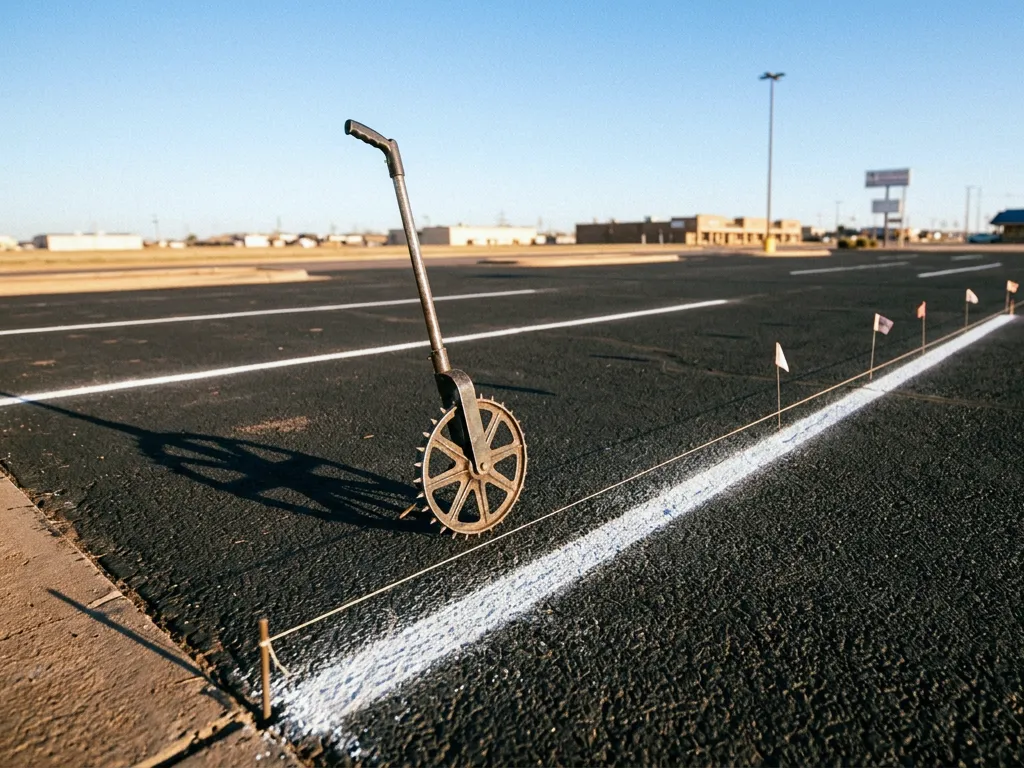
The module is the whole problem
A parking bay is not a stall, it is a module: the depth of a stall, plus the drive aisle, plus the stall facing it. Change the angle and all three numbers move at once. A ninety-degree layout gives the deepest stalls and the widest aisle, and it is the only angle that works properly in two directions. Angled parking gives a shallower module and an easier turn-in, at the cost of one-way circulation and usually a few stalls at the ends of each row.
This is why the answer to how many cars a lot holds is never a rate per square foot. It depends on where the entrances are, whether the aisles can run the long way, and what has to turn around at the end of each row.
| 90 degrees, two-way | 60 ft module | 18 ft stall, 24 ft aisle, 18 ft stall |
|---|---|---|
| 60 degrees, one-way | 59 ft 6 in module | 20 ft 9 in stall, 18 ft aisle, 20 ft 9 in stall |
| 45 degrees, one-way | 51 ft 2 in module | 19 ft 1 in stall, 13 ft aisle, 19 ft 1 in stall |
| 30 degrees, one-way | 44 ft 8 in module | 16 ft 10 in stall, 11 ft aisle, 16 ft 10 in stall |
| Single row plus aisle | Varies | Perimeter rows against a building or fence resolve differently |
What constrains the layout before you start
Three things usually fix the answer before anyone picks an angle. The first is the fire lane, because its width and route are not negotiable against a stall count. The second is the accessible route: accessible stalls have to be on the shortest accessible route to the entrance, which frequently means the most valuable parking on the lot is spoken for before general parking is laid out. The third is whatever delivers to the building.
The delivery vehicle is the one people forget. A lot laid out beautifully for cars, where a WB-40 semitrailer cannot make the turn into the dock, is a lot that will be driven over rather than driven through, and you will see it in the paint within a year.
Fixed points we establish before proposing a layout:
- Fire lane route, width and any required turning radius for apparatus access
- Accessible stall locations, count and the route from stall to entrance
- The largest vehicle that regularly serves the building, and the path it needs
- Existing drainage: where water runs and where it stands after a Texas Panhandle downpour
- Light poles, islands, wheel stops and anything else that cannot move without a contractor
- Entrances and exits, including whether either is right-turn only in practice
Gaining stalls without breaking the lot
There is usually some slack in an older layout, and it is generally in stall width. A lot striped at ten-foot stalls in the 1980s, when vehicles were wider and land was cheaper, can often be re-marked at nine feet and pick up a row. Whether that is a good idea depends on the tenant: a grocery or home-improvement lot with trolleys and long loads wants the extra width, while an office lot where the same people park every day tolerates the narrower stall comfortably.
The other source is the ends of rows, where angled layouts waste a triangle and ninety-degree layouts often do not. Reconciling the two on a lot that has been extended over the years is the most common relayout we do in Amarillo, because so many Texas Panhandle commercial properties grew a piece at a time.
Stall count is not free
Every stall added narrows something. Before we propose a layout that increases the count we will tell you what it costs: a tighter aisle, a harder turn at the end of a row, a delivery path that now needs a three-point turn.
A lot that holds six more cars and annoys every driver in it is not an improvement, and it is not what we will recommend without you asking for it explicitly.
Questions we get asked
How wide should a parking stall be?
Nine feet is the common standard for general commercial parking and it is what most Amarillo lots are laid out at. Eight and a half feet appears on office and employee lots where the same drivers park daily. Ten feet is worth the space on retail with trolleys, on lots serving trades vehicles, and anywhere doors are opened wide routinely. The right answer depends on who parks there, and it is worth deciding deliberately rather than inheriting it.
How wide does the drive aisle need to be?
For ninety-degree stalls with two-way traffic, twenty-four feet is the working figure and it is what fire access generally wants anyway. One-way aisles serving angled parking can come down considerably, to around eighteen feet at sixty degrees and thirteen at forty-five. What we do not do is narrow an aisle to gain stalls without checking the fire lane requirement for that lot first.
Can you tell me how many spaces my lot will hold?
Not accurately from an aerial photograph, which is how a lot of quotes get produced. Obstructions, grade, drainage, entrance positions and the turning path of whatever delivers to the building all change the answer, and none of them are reliably visible from above. We measure the lot and give you a count you can rely on, along with what each option costs in aisle width or turning comfort.
Do angled stalls fit more cars?
Sometimes, and it is genuinely lot-specific. Angled parking has a shallower module, so it fits more rows into a deep lot, but it only works one-way and it wastes a triangle at each end of every row. On a long narrow lot the angle usually wins. On a squarer lot with two-way circulation, ninety degrees usually does. We work both out before recommending either.
Does the layout need approval from the city?
That depends on what is changing and on the property. Re-marking an existing layout as it stands is ordinary maintenance. Changing stall counts, altering circulation, or touching anything related to accessible parking can engage local ordinance requirements or, in Texas, registered accessibility review at certain project thresholds. We are a striping contractor rather than a plan-review service, so where a change looks like it crosses one of those lines we will say so and tell you who needs to look at it.
Next step
Get a written price for your lot
We walk the lot, count what has to be painted, measure the accessible stalls and give you an itemised schedule. No charge for the visit.
MON-FRI 7A-6P · NIGHT AND WEEKEND WORK BY ARRANGEMENT