Amarillo Lot Striping: ADA parking striping in Amarillo, Texas
Amarillo Lot Striping marks accessible parking on commercial property in Amarillo and across the Texas Panhandle, working to the dimensions in the 2010 ADA Standards and the Texas Accessibility Standards that adopt them. On most restripes we are asked to quote, at least one accessible element on the lot does not currently measure what it should, and the owner finds that out from us rather than from a complaint.
What the standards actually require
Accessible parking is governed by three numbers: how many accessible spaces the lot needs, how wide each one and its access aisle must be, and how many of those have to be van accessible. Get any of the three wrong and the lot is non-compliant regardless of how good the paint looks.
The count comes from a table indexed to the total number of spaces in the lot. The dimensions come from section 502 of the 2010 ADA Standards. The van ratio is one in every six accessible spaces, rounded up, which catches out small lots because it means the very first accessible space on a lot has to be van accessible.
| 1 to 25 total spaces | 1 accessible | That one must be van accessible |
|---|---|---|
| 26 to 50 | 2 accessible | |
| 51 to 75 | 3 accessible | |
| 76 to 100 | 4 accessible | |
| 101 to 150 | 5 accessible | |
| 151 to 200 | 6 accessible | At this point a second van space is required |
| 201 to 300 | 7 accessible | |
| 301 to 400 | 8 accessible | |
| 401 to 500 | 9 accessible | |
| 501 to 1000 | 2 percent of total | |
| Over 1000 | 20 plus 1 per 100 over 1000 |
The dimensions, and the one people get wrong
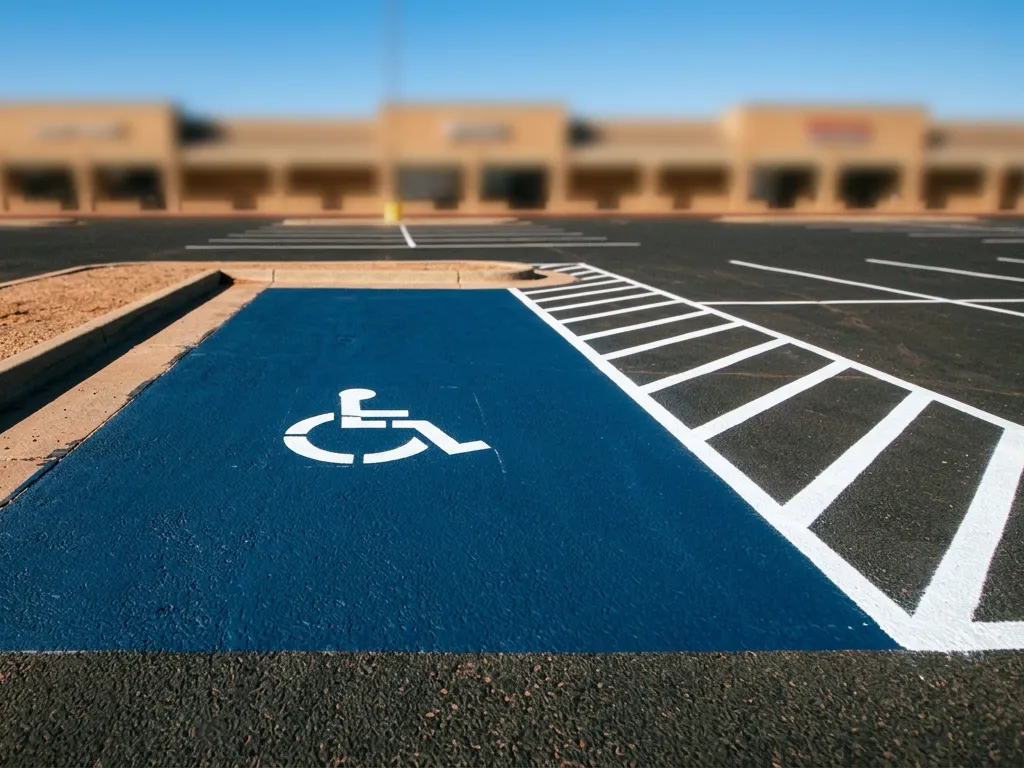
A standard accessible car space is 96 inches wide with an adjacent access aisle at least 60 inches wide. A van accessible space is either 132 inches wide with a 60 inch aisle, or 96 inches wide with a 96 inch aisle. Two accessible spaces may share one access aisle between them.
The element that most often fails is the access aisle, because it looks like wasted space and it is the first thing to disappear when somebody restripes a lot to gain a stall. An access aisle is not spare pavement. It is the space a wheelchair lift deploys into, and a car parked in it makes the adjacent accessible space unusable.
The second most common failure is slope. The standards require accessible spaces and their access aisles to be level in all directions within the tolerance the standard allows for drainage. Paint cannot fix a slope, and a lot that drains across its accessible stalls has a problem no striping contractor can resolve with a brush.
| Car space width | 96 in minimum | |
|---|---|---|
| Van space width | 132 in minimum | Or 96 in where the access aisle is 96 in |
| Access aisle width, car | 60 in minimum | |
| Access aisle width, van | 96 in minimum | Where the van space itself is 96 in |
| Access aisle length | Full length of the space it serves | |
| Aisle marking | Marked so as to discourage parking in it | Hatching is the usual treatment |
| Van ratio | 1 in every 6 accessible spaces | Rounded up. A lot with one accessible space needs it to be van accessible |
| Location | On the shortest accessible route to the entrance |
Texas adds a layer, and it is worth knowing which one applies
Texas has its own accessibility standards, the Texas Accessibility Standards, administered by the Texas Department of Licensing and Regulation under Chapter 469 of the Government Code. TAS is built on the 2010 ADA Standards, so the parking dimensions above are the same, but the administration is not: in Texas, construction projects over a cost threshold set in statute have to be submitted to TDLR for plan review and inspected by a Registered Accessibility Specialist.
That matters on a striping job when the work stops being maintenance and starts being alteration. Repainting the accessible stalls you already have, exactly where they are and at the dimensions they already meet, is maintenance. Relocating them, adding them, or changing the accessible route is a different conversation, and depending on the scope and cost of the wider project it may be one that involves TDLR.
We measure and report. We do not certify
Amarillo Lot Striping is a striping contractor. We are not a Registered Accessibility Specialist, we do not perform TAS plan review, and nothing we hand you is a certification of compliance.
What we do is measure the accessible elements on your lot, write down what we found, and paint to the dimensions the standards specify. Where the work looks to us like it crosses into alteration, or where something on the lot cannot be fixed with paint, we say so and tell you that the question belongs with a Registered Accessibility Specialist or the authority having jurisdiction. Getting that boundary right protects you more than a confident answer would.
What we find on Amarillo lots
A great many commercial lots on the Texas Panhandle were laid out before the 2010 standards took effect and have been restriped since by somebody following the old lines. The paint is current. The geometry is not. The pattern is consistent: a 96 inch space with no access aisle at all, an aisle narrowed to 48 inches to keep a stall, or four accessible spaces with no van space among them.
On every accessible stall we quote, we record:
- Stall width and access aisle width, measured rather than estimated
- Whether the aisle is marked so as to discourage parking in it
- Whether at least one space in six is van accessible
- Total lot count against the required accessible count
- Whether the accessible spaces sit on the shortest accessible route to the entrance
- Signage present, and whether it is mounted high enough to be visible above a parked vehicle
- Anything that paint cannot fix, most often cross slope or a route obstructed by a kerb with no ramp
Questions we get asked
How many accessible spaces does my lot need?
It is set by the total number of spaces in the lot, from the table in section 208.2 of the 2010 ADA Standards, and the table above gives the whole range. The figure that surprises people is the van requirement: one in every six accessible spaces, rounded up, so a small lot with a single accessible space needs that space to be van accessible.
How wide does the access aisle have to be?
At least 60 inches for a car space, and 96 inches where a van space is provided at the 96 inch width rather than the 132 inch width. It has to run the full length of the space it serves and be marked so people do not park in it. Two accessible spaces can share a single aisle between them, which is the usual arrangement on a pair.
Can you just repaint our accessible spaces the way they are?
If they measure correctly, yes, and that is the straightforward case. If they do not, we will tell you what we measured before we paint anything. Repainting an undersized accessible space reproduces the problem in fresh paint, and the decision about what to do next is yours to make with the facts in front of you rather than ours to make quietly with a spray gun.
Do we need a Registered Accessibility Specialist for a restripe?
Ordinary maintenance restriping generally is not the kind of work that triggers TDLR review. Alterations can be, depending on scope and construction cost against the threshold in Chapter 469. We are not the right people to give you that determination, and where the scope looks like it might cross the line the question goes to a Registered Accessibility Specialist or the authority having jurisdiction before we paint.
Does the accessibility symbol have to be painted on the ground?
The standards require accessible spaces to be identified by a sign bearing the International Symbol of Accessibility, mounted high enough that it stays visible when a vehicle is parked in the space. A painted symbol on the pavement is extremely common, is useful, and is required by some jurisdictions and site approvals, but a painted symbol on its own does not replace the sign.
Our lot slopes. Is that a problem?
It can be. Accessible spaces and their access aisles have to be essentially level in all directions, within the small tolerance the standards allow for drainage. Paint cannot change a slope. Where we measure a cross slope outside tolerance we will tell you, and the fix is a paving or grading question rather than a striping one.
Next step
Get a written price for your lot
We walk the lot, count what has to be painted, measure the accessible stalls and give you an itemised schedule. No charge for the visit.
MON-FRI 7A-6P · NIGHT AND WEEKEND WORK BY ARRANGEMENT